
3D Printing
Transforming innovative ideas into reality through high-quality 3D printing.
3D Printing
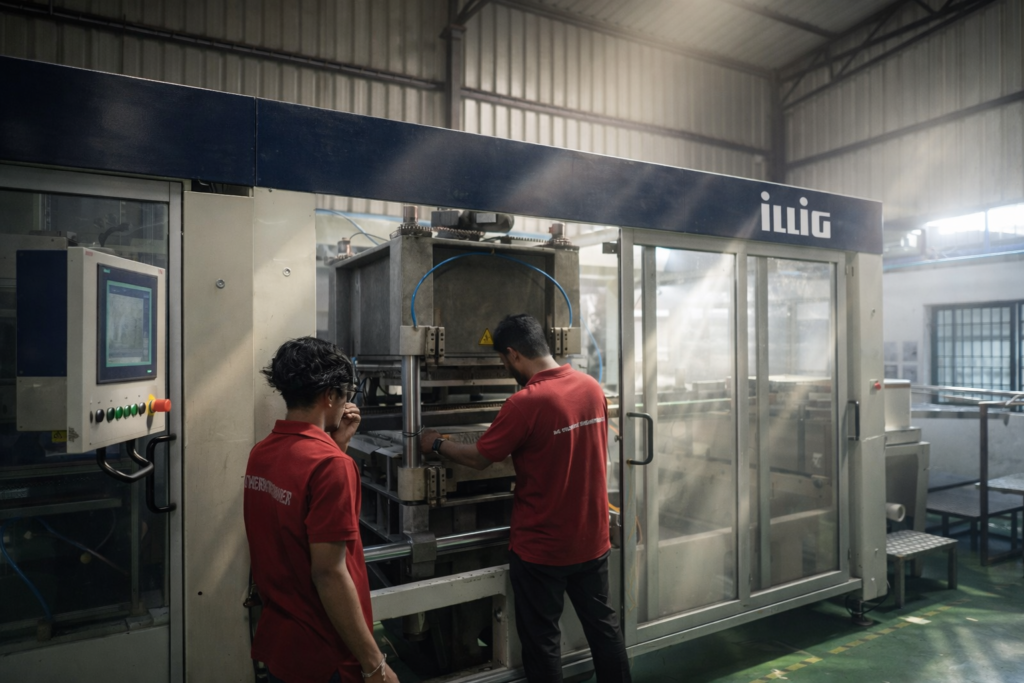
3D printing, also known as additive manufacturing, is revolutionizing the way products are designed and developed. By converting digital designs into physical objects layer by layer, this technology enables rapid prototyping, design validation, and efficient manufacturing across multiple industries.
At DM Thermoformer & RA Vacform Industries, 3D printing plays an important role in accelerating product development, improving design accuracy, and supporting innovative engineering solutions.
What Is 3D Printing and Why It’s Changing the World
3D printing (also called additive manufacturing) is a process that builds physical objects layer by layer from a digital 3D model. Instead of cutting or shaping material like in traditional machining, a 3D printer deposits material—usually plastic, resin, or metal—until the final object is formed. This technology is now used in industries ranging from healthcare and aerospace to fashion and education.
How Does 3D Printing Work?
Most 3D printers start with a 3D design created in software such as Fusion 360, Tinkercad, Blender, or SolidWorks. This model is then exported as an STL or OBJ file and “sliced” by special software that converts it into thin layers and generates printer‑specific instructions (G‑code). The printer reads this code and builds the object one layer at a time, heating and extruding filament (in FDM), curing liquid resin with light (in SLA), or fusing powder with a laser (in SLS).
Common Types of 3D Printing
-
FDM (Fused Deposition Modeling): Uses a heated nozzle to melt thermoplastic filament and deposit it in layers. It is the most common and affordable for hobbyists and small businesses.
-
SLA (Stereolithography): Uses ultraviolet light to cure liquid resin, producing very smooth and detailed parts ideal for prototypes and jewelry‑scale models.
-
SLS (Selective Laser Sintering): Uses a laser to fuse powdered material (often nylon or metal), creating strong, complex parts used in industrial and aerospace applications.
3D printing, also known as additive manufacturing, is revolutionizing the way products are designed and developed. By converting digital designs into physical objects layer by layer, this technology enables rapid prototyping, design validation, and efficient manufacturing across multiple industries.
At DM Thermoformer & RA Vacform Industries, 3D printing plays an important role in accelerating product development, improving design accuracy, and supporting innovative engineering solutions.
Key Benefits of 3D Printing
-
Design Freedom: You can create complex shapes, internal channels, and lightweight structures that are hard or impossible to make with traditional methods.
-
Faster Prototyping: Engineers can print and test multiple design iterations in hours instead of weeks.
-
Low‑Volume Production: Small runs and custom parts are much cheaper and easier to produce without expensive molds or tooling.
-
Less Waste: Material is added only where needed, reducing scrap compared with milling or cutting.
Applications of 3D Printing
Healthcare and Medical Devices
3D printing is used to create patient‑specific implants, surgical guides, dental models, prosthetics, and even bioprinted tissues for research. This customization helps surgeons plan complex operations and improves recovery outcomes.
Aerospace and Automotive
Engineers in aerospace and automotive industries use 3D printing to make lightweight, high‑performance parts such as fuel nozzles, brackets, and interior components. Complex geometries can be printed as single pieces, reducing assembly time and weight.
Manufacturing and Tooling
Factories print jigs, fixtures, and molds, which speeds up production and reduces costs. Custom tooling tailored to specific tasks helps operators handle parts more safely and efficiently.
Architecture and Construction
Architects print scale models to visualize designs, while some construction projects use large‑format 3D printers to create walls, formwork, or even small houses with minimal waste.
Education and Hobbies
Schools and universities use 3D printers to teach engineering, design, and biology with tangible models. Hobbyists print everything from toys and phone cases to cosplay props and replacement household parts.
Popular Materials Used in 3D Printing
-
PLA (Polylactic Acid): Easy to print, biodegradable, and good for prototypes and decorative items.
-
ABS (Acrylonitrile Butadiene Styrene): Stronger and more heat‑resistant, used for functional parts.
-
Resins (for SLA): Provide high detail and smooth surfaces for dental models, jewelry, and figurines.
-
Nylon and Metal Powders (for SLS): Used when high strength, durability, or temperature resistance is required.